 Official website
Ingredient #5 of 8
Quercetin Supplement and Nerves: What 8 mg in Nervecept Means
Quercetin is a plant pigment that Nervecept lists as quercetin from Sophora japonica bud, 8 mg per capsule. That is 1.1 percent of the 699 mg total. The one safety trial we found used 500 to 2,000 mg a day for 7 days in 9 people. No source shows quercetin helps nerves.
Written by the Nervecept label deskUpdated
The basics01
What is quercetin in Nervecept?
Quercetin is a flavonoid, a plant pigment found in onions, apples, tea and citrus fruit (MSK, Quercetin). In Nervecept it is the fifth line on the label, listed as quercetin (Sophora japonica, bud), 8 mg per capsule.
Sophora japonica is a tree, and the bud is the part used. The label does not say whether the 8 mg is pure quercetin or a bud extract that contains it. It does not name a supplier or a grade.
Memorial Sloan Kettering says it has not been shown to treat cancer or other diseases, and the human studies it cites are few and mixed (MSK, Quercetin). That is the honest starting point for any quercetin supplement and nerve question.
The table below is the profile for this line, built from the label.
| Name on the label | Quercetin (Sophora japonica)(bud) |
|---|---|
| What it is | Plant flavonoid from Sophora japonica buds |
| Place on the label | 5 of 8, most to least by weight |
| Amount per capsule | 8 mg per capsule (1.1% of the 699 mg listed) |
| Amount used in research | 500-2,000 mg a day in a 7-day safety trial of 9 people |
| Strength of evidence | Not shown to treat disease |
| Marketed or traditional use | Plant pigment sold as an antioxidant |
| Main caution | An elevated INR was reported in a warfarin patient. |
Amount math02
How much quercetin is in one Nervecept capsule?
One Nervecept capsule holds 8 mg of quercetin. A 30-capsule bottle holds 240 mg in all, at one capsule a day.
The label lists 699 mg per capsule across eight lines. Eight of 699 is 1.1 percent. The capsule below is drawn to scale, and the quercetin piece is one of four thin slivers at the end.
699 mgin one capsule, eight label lines, drawn to scale
- Glucosamine sulfate500 mg71.5%
- Indian frankincense67 mg9.6%
- Chondroitin sulfate50 mg7.2%
- Turmeric50 mg7.2%
- Quercetin8 mg1.1%
- Methionine8 mg1.1%
- MSM8 mg1.1%
- Bromelain8 mg1.1%
Methionine, MSM and bromelain are also 8 mg each. Together the four small lines weigh 32 mg, which is 4.6 percent of the capsule. Glucosamine sulfate alone is 500 mg.
No Daily Value is set for quercetin, so the label cannot show a percentage of a daily need. The only anchor is what researchers have given people, which we cover next.
Label vs study03
Is 8 mg of quercetin close to the studied dose?
No. The one human safety trial we found gave 500, 1,000 or 2,000 mg a day, and 8 mg is far below all three (Han et al. 2020, Quercetin Safety Trial).
Take the lowest studied dose. Eight mg is 1.6 percent of 500 mg. Against 2,000 mg it is 0.4 percent. To swallow 500 mg from Nervecept you would need about 63 capsules in one day, which the label forbids. Never try it.
A study at 2,000 mg says little about 8 mg.
The trial looked at safety, not benefit. Patients with COPD, a lung disease, took it for 7 days. Nine were analyzed: 6 on quercetin and 3 on placebo. No serious adverse events were reported (Han et al. 2020, Quercetin Safety Trial).
Evidence04
Does a quercetin supplement help nerves?
We found no source that shows a quercetin supplement helps nerves, numbness or tingling. The research we could verify is about safety and general antioxidant interest, not neuropathy.
The trial above was not in people with neuropathy (Han et al. 2020, Quercetin Safety Trial). Memorial Sloan Kettering lists no nerve use (MSK, Quercetin). The NCCIH page on diabetes and supplements says that for most supplements there is no evidence of benefit for diabetes or its complications (NCCIH, Diabetes and Dietary Supplements).
The same page names one supplement it discusses for nerve pain in diabetes: alpha-lipoic acid. A 2022 review of 8 studies was mixed, with 3 reporting symptom improvement and 5 not (NCCIH, Diabetes and Dietary Supplements). Alpha-lipoic acid is not in Nervecept.
So the front-label wording "Nerve Repair Formula" is a product name. It is not a finding about quercetin. Read the claims side by side on the Nervecept benefits review.
Safety05
Is quercetin safe with warfarin and other medicines?
Quercetin can matter if you take warfarin or other medicines cleared by certain liver enzymes. Ask your pharmacist before taking Nervecept in that case.
A 79-year-old man on stable warfarin had a higher INR after he started quercetin. It went back to normal when he stopped (MSK, Quercetin). INR is the blood test that tracks how thin the blood is.
In lab tests, quercetin also blocked two liver enzymes, CYP3A4 and CYP2C19. The page advises against combining it with drugs those enzymes clear (MSK, Quercetin). Lab results do not always carry over to people, but they are the reason for the caution.
Nervecept holds only 8 mg, and we found no data on whether that amount acts the same way. Other lines add their own notes, such as turmeric for blood thinners.
Ask a pharmacist if
You take warfarin or another blood thinner, or any medicine your pharmacist says is cleared by CYP3A4 or CYP2C19.
Ask a physician if
You are pregnant or nursing, under 18, or have a known medical condition. The label says the same.
Skip it if
You have a shellfish allergy. The label states: Contains: Shellfish (Crayfish).
Keep taking prescribed medicine exactly as directed. A supplement does not stand in for it.
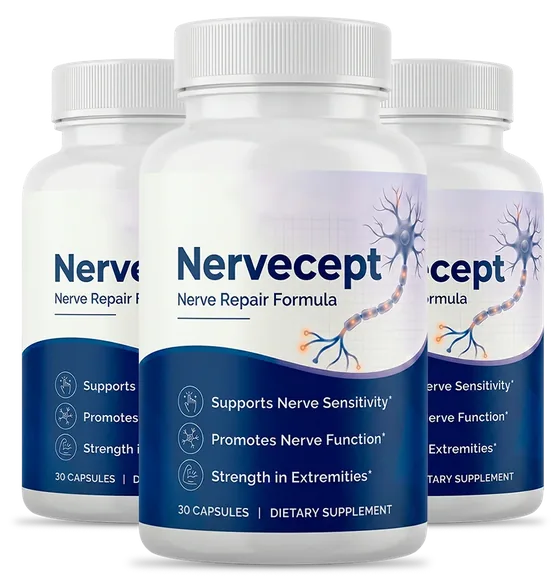
Nervecept: from $49 a bottle30 capsules · 2, 3 or 6 bottles · free US shipping on 3 and 6 · 60-day money-back guarantee
See packsLabel checks06
What should you check on any quercetin supplement label?
Check four things on any quercetin label: the plant source, the milligrams per serving, the other ingredients and the allergen line. Nervecept gives three of those and leaves one open.
| Check | What the label shows | What is missing |
|---|---|---|
| Plant source | Sophora japonica, bud | Whether it is an extract |
| Amount | 8 mg per capsule | Purity of the quercetin |
| Allergen | Contains shellfish (crayfish) | Source of that allergen is glucosamine |
| Maker | Distributor named; maker not named | Who blends and fills the capsules |
A quercetin bottle at 500 mg and one at 8 mg are different products, even if the front says the same word. Read the Supplement Facts, not the headline.
The full panel is typed out on the Nervecept supplement facts page.
In context07
Where does quercetin fit in the whole Nervecept capsule?
Quercetin is a minor line in Nervecept. Four of its eight lines weigh 8 mg or less, and glucosamine sulfate makes up 71.5 percent of the capsule.
The larger lines drive most of what you swallow. See glucosamine sulfate first.
Nervecept is a dietary supplement, and the FDA does not approve supplements (FDA, Dietary Supplements).
Before you buy08
When should you see a doctor instead of adding quercetin?
See a doctor for new, spreading or worsening numbness, weakness, balance trouble, or a foot sore you cannot feel. A supplement is not a first step for those.
Nerve problems have causes that can be found and sometimes corrected, such as diabetes or low vitamin B12 (NINDS, Peripheral Neuropathy) (NIH ODS, Vitamin B12). Read when to see a doctor about numbness.
The sales page lists a 60-day money-back guarantee (Nervecept sales page). Confirm the terms at checkout.
See the Nervecept packsMore ingredient pages
FAQ09
Quercetin and Nervecept: common questions
How much quercetin is in Nervecept?
Each Nervecept capsule lists 8 mg of quercetin from Sophora japonica bud. That is 1.1 percent of the 699 mg total. A 30-capsule bottle holds 240 mg of quercetin at one capsule a day.
What is quercetin made from in Nervecept?
The label says Sophora japonica, bud. Sophora japonica is a tree, and the bud is the plant part used. The label does not say whether this is a plain powder or a standardized extract.
Is 8 mg of quercetin a lot?
No. A small safety trial used 500, 1,000 or 2,000 mg a day, so 8 mg is 1.6 percent of the lowest studied dose. The trial tested safety in nine people, not any benefit.
Can you take quercetin with warfarin?
Ask your pharmacist first. A report describes a man on stable warfarin whose INR rose after starting quercetin. It normalized when he stopped. Nervecept has only 8 mg, but we found no data on that amount.
Does quercetin protect nerves?
We found no source that says so. Memorial Sloan Kettering says quercetin has not been shown to treat disease, and the human studies are few and mixed. The safety trial was not in people with neuropathy.
Does Nervecept list quercetin as a proprietary blend?
No. The label prints every line with its own milligrams, including quercetin at 8 mg. The sales page FAQ mentions a "proprietary blend", but the label does not use one.
Who wrote this10
Written and reviewed by
Pages built from the label, the sales page and linked NIH, FDA, CDC, FTC and peer-reviewed sources.
Last updated . See our editorial standards and how we check reviews. This website is run by a licensed U.S. retail desk for Nervecept, not by the manufacturer or the distributor. We are paid a commission when you buy through our order links.
Keep reading
More about Nervecept
Licensed U.S. retail desk for Nervecept
Ready to try Nervecept?
Check your medicines and the shellfish line first, then pick a pack. Six bottles cost the least per bottle; three and six ship free in the US; every pack carries the 60-day money-back guarantee.
- Secure checkout on the sales page
- 60-day money-back guarantee
- Ships from the U.S.